
🌐
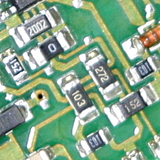
Values such as 22 nF (0.022 μF) or 47 kΩ, which are often found in electronic components, may seem somewhat strange when you encounter them for the first time. Such values are referred to as the E6, E12, and E24 series. They are recommended values for resistors and capacitors, prepared by the International Electrotechnical Commission�fs (IEC) Technical Committee (TC) No.40, "Resistors and Capacitors", and are defined in IEC 60063 (JIS C 5063 in Japan).
At the 1948 meeting of IEC TC No. 12, Radio-communication, in Stockholm,
it was unanimously agreed that one of the most urgent matters for international standardization was
a series of recommended values for resistors and capacitors up to 0.1 μF.
It might have been desirable to standardize the 10√10 series system,
but in several countries, the 12√10 series system had been adopted
due to the standardization of 5%, 10%, and 20% tolerance for the aforementioned components.
Changing this was unrealistic, so the 12√10 system was adopted .
In 1950 a proposal for recommended values for the E6, E12 and E24 series was adopted in Paris,
and subsequently published as I.E.C. Publication 63.
Unfortunately, I do not know how the specific numbers were decided by the Technical Committee. However, it turns out that the E24 series subtly deviates from the values rounded to two digits after dividing one digit into 24 equal parts in a geometric progression. This deviation occurs around one third of a digit, between 2.7 and 4.7 (See Table 1).
Table 1 [ E24 / E12 / E6 Series and Geometric Series ]
E24 series
(5 % tolerance)E12 series
(10 % tolerance)E6 series
(20 % tolerance)12√10 Geometric series
1.0 1.0 1.0 1.000 1.1 1.100~ 1.2 1.2 1.211~ 1.3 1.333~ 1.5 1.5 1.5 1.467~ 1.6 1.615~ 1.8 1.8 1.778~ 2.0 1.957~ 2.2 2.2 2.2 2.154~ 2.4 2.371~ 2.7 2.7 2.610~ 3.0 2.872~ 3.3 3.3 3.3 3.162~ 3.6 3.480~ 3.9 3.9 3.831~ 4.3 4.216~ 4.7 4.7 4.7 4.641~ 5.1 5.108~ 5.6 5.6 5.623~ 6.2 6.189~ 6.8 6.8 6.8 6.812~ 7.5 7.498~ 8.2 8.2 8.254~ 9.1 9.085~
Thanks to this, you may appreciate the exquisite balance in choosing these values when designing circuits, as you can make the ratio or product of multiple elements a nice value, or slightly larger or smaller. In actual electronic circuits, especially analog circuits, it is often more important to have a product or ratio of values rather than the absolute value of components, such as time constants or the gain of an amplifier. Particularly, thanks to the adoption of '3.0' instead of '2.9', it is truly appreciated that ratios such as
1 : 2 : 4 → 75 : 150 : 300can be created. If you look at Table 2, you can see that most of the practical magnifications can be realized with the ratio of the E24 series.
or
1 : 4 : 5 : 6 : 8 : 9 : 10 : 11 : 12 : 13 : 17 → 3 : 12 : 15 : 18 : 24 : 27 : 30 : 33 : 36 : 39 : 51
or even reciprocally
4 : 6 : 8 : 9 : 12 → 1 / 36 : 1 / 24 : 1 / 18 : 1 / 16 : 1 / 12
Table 2 [Examples of practical magnifications obtained with ratios in the E24 series]
× magnifications E24 value / E24 value (error) × 0.268~ ( 2 -√3) 15 / 56 (+0.034%), 22 / 82 (-0.13%) × 0.293~ ( 1 - 1 / √2) 24 / 82 (+0.072%), 22 / 75 (-0.15%) × 0.414~ (√2 - 1) 91 / 22 (+0.14%), 6.2 / 15 (+0.21%) × 0.732~ (√3 - 1) 11 / 15 (-0.18%), 22 / 30 (-0.18%) × 1.1 11 / 10, 22 / 20, 33 / 30 × 1.2 (6 / 5) 12 / 10, 18 / 15, 24 / 20, 36 / 30 × 1.25 (5 / 4) 15 / 12, 20 / 16, 30 / 24 × 1.33~ (4 / 3) 100 / 75, 16 / 12, 20 / 15, 24 / 18, 36 / 27, 68 / 51 × 1.4 (7 / 5) 18 / 13 (-1.1%) × 1.41 (√2) 51 / 36 (-0.17%), 130 / 91 (-1.0%) × 1.5 (3 / 2) 15 / 10, 18 / 12, 24 / 16, 27 / 18, 30 / 20, 33 / 22, 36 / 24 × 1.6 (8 / 5) 120 / 75, 16 / 10 × 1.66~ (5 / 3) 20 / 12, 30 / 18 × 1.73 (√3) 130 / 75 (-0.07%) × 1.75 (7 / 4) 82 / 47 (-0.3%) × 1.8 (9 / 5) 18 / 10, 27 / 15, 36 / 20 × 2 150 / 75, 20 / 10, 22 / 11, 24 / 12, 30 / 15, 36 / 18 × 2.16~ (√10 - 1) 39 / 18 (+0.2%), 11 / 51 (+0.25%) × 2.2 (11 / 5) 22 / 10, 33 / 15 × 2.25 (9 / 4) 27 / 12, 36 / 16 × 2.33~ (7 / 3) 56 / 24, 91 / 39 × 2.5 (5 / 2) 30 / 12, 75 / 30 × 2.6 (13 / 5) 39 / 15 × 2.66~ (8 / 3) 200 / 75 × 2.75 (11 / 4) 33 / 12 × 2.8 (14 / 5) 56 / 20 × 3 3 / 1, 33 / 11, 36 / 12, 39 / 13 × 3.16~ (√10) 16 / 5.1 (+0.78%), 51 / 16 (+0.79%) × 3.2 (16 / 5) 240 / 75 × 3.25 (13 / 4) 39 / 12 × 3.4 (17 / 5) 51 / 15, 68 / 20 × 3.5 (7 / 2) 56 / 16 × 3.75 (15 / 4) 75 / 20 × 4 12 / 3, 300 / 75 × 4.25 (17 / 4) 51 / 12, 68 / 16 × 4.5 (9 / 2) 68 / 15 (+0.7%) × 5 75 / 15, 10 / 20, 11 / 22, 12 / 24, 15 / 3, 180 / 36 × 5.5 (11 / 2) 11 / 2 × 6 12 / 2, 18 / 3 × 6.5 (13 / 2) 13 / 2 × 7 91 / 13 × 7.5 (15 / 2) 120 / 16, 15 / 2, 180 / 24, 270 / 36, 510 / 68, 75 / 10 × 8 120 / 15, 16 / 2, 24 / 3 × 8.5 (16 / 2) 330 / 39 (+0.45%) × 9 18 / 2, 27 / 3
The E24 series was likely designed with consideration for both a just intonation scale (akin to a pure tone scale) and a well-tempered scale (akin to a mean scale), in order to facilitate the realization of favorable ratios.
Resistance tolerances are mainly determined by rounding the R3 series (Renard numbers) to the nearest digit, primarily using the 1-2-5 series.
Table 3 [Example of tolerance code]Compliant with IEC60062:2016 (JIS C 5062, JIS C 60062:2019 in Japan).
code tolerance [%] series color code (S) 0.0010 (U) 0.0020 (X) 0.0025 E(V) 0.0050 L(T) 0.01 (Grey) P(H) 0.02 (Yellow) W(A) 0.05 Orange B 0.10 Purple C 0.25 Blue D 0.50 E192 Green F 1 E96 Brown G 2 E48 Red J 5 E24 Gold K 10 E12 Silver M 20 E6 plane
The code in parentheses () are examples of extensions by resistor manufacturers (e.g. Vishay).
The capacitance of capacitors primarily uses the E series, such as E6 or E12. However, the rated voltage uses values based on the R10 standard numbers (Renard numbers). The rated voltage of the capacitor represents the exponent as a number in the first character and the mantissa as an uppercase English letter in the second character. The mantissa corresponds to the R10 standard numbers {1.0, 1.25, 1.6, 2.0, 2.5, 3.15, 4.0, 5.0, 6.3, 8.0} with {A, B, C, D, E, F, G, H, J, K}.
Table 4 [Examples of rated voltages and their codes]Compliant with IEC 60384-1:2016 (JIS C 5101-1:2019 in Japan)
Code Tolerance
[V]0E 2.5 0G 4.0 0L 5.5 0J 6.3 1A 10 1B 12.5 1C 16 1D 20 1E 25 (1V) 35 1G 40 1H 50 1J 63 1K 80 2A 100 (2Q) 110 2B 125 2C 160 (2P) 180 2D 200 2E 250 2F 315 (2V) 350 2G 400 (2W) 450 2H 500 2J 630 3A 1000 3B 1250 3C 1600 3D 2000
The code in parentheses () are examples of extensions by resistor manufacturers.
As an aside, in JIS C 5101-1:2010 (IEC 60384-1:2008) under
2.3.3 Recommended values of rated voltagethere was a note statingNote 2: In particular, if necessary, the rated voltages of 35V, 350V, and 450V from the R20 standard number series may be used.However, this statement was removed in JIS C 5101-1:2019 2.3.3.Column — 350V or 450V
Modern power-supply designs are increasingly converging on a DC bus voltage around 400 V, driven by the widespread adoption of universal input and active PFC stages. As a result, rated voltages such as 275 V, 315 V, and 350 V, which were once well aligned with rectified mains systems, are gradually losing their architectural relevance. In contrast, 450 V and 500 V provide a more practical margin above the 400 V DC bus and are widely used in applications such as EVs, UPS systems, and industrial inverters, where high production volumes support long-term availability. For film and electrolytic capacitors, the rated voltage is not merely a matter of margin: it directly affects dielectric thickness, package size, and cost, making it difficult to substitute parts once certain voltage classes disappear from the market. For this reason, in new designs it is advisable not only to consider the immediate electrical requirements, but also to take into account the likely long-term availability of voltage classes such as 450 V, 500 V, and 630 V.
Table 5 [Temperature Coefficients TC of Class-1 ceramic capacitors]Excerpt from IEC 60384-8:2015 (JIS C 5101-8:2018 in Japan)
Code TC
ppm / °CTC tolerance
ppmColor code C0G 0 ±30 Black P2G -150 ±30 Orange R2G -220 ±30 Yellow S2H -330 ±60 Green T2H -470 ±60 Blue U2J -750 ±120 Violet SL +350 ∼ -1000 Gray
Ceramic capacitors for temperature compensation other than zero temperature coefficient (C0G, NP0 characteristics, etc.) are almost extinct as of 2023, leaving only a few with P2G and U2J characteristics.
code# value code# value code# value code# value 01# 100 02# 102 03# 105 04# 107 05# 110 06# 113 07# 115 08# 118 09# 121 10# 124 11# 127 12# 130 13# 133 14# 137 15# 140 16# 143 17# 147 18# 150 19# 154 20# 158 21# 162 22# 165 23# 169 24# 174 25# 178 26# 182 27# 187 28# 191 29# 196 30# 200 31# 205 32# 210 33# 215 34# 221 35# 226 36# 232 37# 237 38# 243 39# 249 40# 255 41# 261 42# 267 43# 274 44# 280 45# 287 46# 294 47# 301 48# 309 49# 316 50# 324 51# 332 52# 340 53# 348 54# 357 55# 365 56# 374 57# 383 58# 392 59# 402 60# 412 61# 422 62# 432 63# 442 64# 453 65# 464 66# 475 67# 487 68# 499 69# 511 70# 523 71# 536 72# 549 73# 562 74# 576 75# 590 76# 604 77# 619 78# 634 79# 649 80# 665 81# 681 82# 698 83# 715 84# 732 85# 750 86# 768 87# 787 88# 806 89# 825 90# 845 91# 866 92# 887 93# 909 94# 931 95# 953 96# 976 # EIA-96 SMD resistor multiplication factors: Z 0.001 Y | R 0.01 X | S 0.1 A 1 B | H 10 C 100 D 1000 E 10000 F 100000 e.g. 84C : 732 x 100 = 73.2 kOhmNote:
Ris the traditional radix-point symbol in resistor markings (cf. IEC 60062 RKM code).
SandHoriginate from legacy Asian manufacturer marking systems, but are not defined in the EIA-96 specification.
▼ unfold / foldThis article is a modified version of the E24 series article that appeared in the May 2008 issue of Transistor Technology.
REFERENCE
- CSI IEC 60063, PREFERRED NUMBER SERIES FORRESISTORS AND CAPACITORS
- Takayuki HOSODA, "Q1-2 Why are the resistor values 1, 2.2, 3.3, 4.7 ... so close together?", Transistor Technology, May 2008, p.p.104-105, CQ Publishing
SEE ALSO
- Find the nearest fraction in the E24 numbers (for HP 42S)
- Find the nearest fraction in the E24 numbers (for HP 35s)
External links
- Preferred number - E24 numbers defined in the IEC 60063 (JIS C 5063)

© 2000 Takayuki HOSODA.